Average Percentage of School Funding for Sports Vs the Arts
Several years ago I was at a dinner political party with some friends from my gym. When the conversation turned to the local opera season, I started to describe what it used to be like to wait in line for standing-room tickets to the Metropolitan Opera before long afterward it moved from the old opera house on Broadway and West 39th Street to Lincoln Center. At the time, many opera lovers would army camp out in the tunnels under Lincoln Center all weekend, waiting for the box office to open on Sunday forenoon.
The line for tickets was highly disciplined, with regular cheque-ins for those who were attention matinee and evening performances during the weekend. In the wee hours of the night, you could hear someone playing a record of Maria Callas singing Aida in Mexico City or listen to heated discussions between the Tebaldi and Callas claques. No one ever got drunk, no 1 started fights, no one misbehaved.
The people I met ranged from music students to 88-twelvemonth-erstwhile Mrs. McKnight (who would scalp her opera tickets in club to help pay for her rent and food). They all shared a passion for classical music and opera.
When I asked some of my friends what they did during their college years, one of the jocks at the table (who had attended the University of Illinois at Urbana-Champaign) replied: "I take no thought. We were drunk every weekend. Tin can't remember a thing!"
Ironically, the folks who are quick to cut funding for school arts programs are often in favor of increased funding for sports facilities and able-bodied teams at the schools their children nourish. These are the same people whose extremely unsportsmanlike behavior can be seen in the following news clip:
When one compares the results of many sports and arts programs in our schools, one quickly realizes that:
- Sports programs are frequently an entry bespeak to institutionalized drinking. (Wikipedia even has a page devoted to "football hooliganism").
- Arts programs tend to be a lot calmer (have you ever heard of an audition member beingness trampled to decease during a performance of Fiddler on the Roof, Phantom of the Opera, or Wicked?).
- Sports programs often teach kids the importance of winning at all costs.
- Arts programs like theater, dance, band, and chorus teach students to sharpen their skills while working toward a shared goal.
- Sports programs often involve crude physical contact that tin lead to bodily injury.
- Arts programs tend to be more expressive than combative.
- Sports programs often foster an atmosphere of dominance and hostility in which athletes are encouraged to humiliate their opposition as "losers" (this includes institutionalized bullying past coaches, parents, opponents, and fans).
- Arts programs are designed to help talented children blossom and thrive.
- Sports programs have occasionally suffered unnecessary deaths on the playing field.
- Arts programs have nevertheless to report anyone dying while playing a musical instrument or reading a poem.
- Sports teams oftentimes ask for God's blessing to help them beat the competition.
- Arts programs teach students how to achieve within themselves for inspiration.
- Sports programs often produce extremely competitive students whose careers may peak early on in life.
- Arts programs often produce extremely creative students whose critical thinking skills and power to conform to new situations deepen as they mature.
Despite the machinations of Jane Lynch's evil Motorcoach Sue Sylvester, the musical-theater plan in Glee continues to thrive. In the long run, information technology's not merely a question of funding. Exposure to the arts helps to build a much stronger foundation for a young person's future than merely being taught to conquer and destroy any opposition or "accident upward shit."
Two new documentaries (which are currently receiving their world premieres at the Manufacturing plant Valley Moving picture Festival) focus on the huge impact theater programs have on the lives of teenagers.
* * * * * * * * * * * *
Trust: 2d Acts In Immature Lives is the third installment in a thematic trilogy about the transformative power of fine art by independent filmmakers Nancy Kelly and Kenji Yamamoto. This documentary is tightly focused on Chicago's Albany Park Theatre Project, a multi-ethnic neighborhood teen theater company that creates original plays from members' stories while encouraging teenagers to use the dramatic process as a course of therapy. Equally their website explains:
Our theater comes from the real-life stories we get together from immigrant and working-class Americans. APTP brings to the stage an assortment of voices often not heard on other stages: our plays have shared the life experiences of Mexican indocumentados, Bosnian refugees, Bolivian revolutionaries, persecuted Ukrainian Jews, Palestinian-American Muslims, Western farsi Sufis, Smoothen domestics, Vietnamese refugees, and more. Telling the stories of our customs ways that nosotros examine bug that are important to people in neighborhoods like Albany Park. APTP'due south plays have told the stories of people whose lives are impacted by immigration policy, globalization, war, inequalities in public didactics, poverty, child abuse and neglect, habit, domestic violence, gang violence, the criminal justice system, prejudice and intolerance, gentrification, and more than."
The subject of the APTP production around which this documentary is built is a young girl who, when she was just 12 years old, was raped by ii men in the bath of her grandmother's church in Honduras. At the time, Marlin told no one what had happened.
Two years later, Marlin and her older brother Carlos left Honduras to live with their female parent in Chicago, where Carlos repeatedly raped her. Marlin, who felt she'd already lost everything in her life, didn't resist. However, she somewhen shared her underground with a counselor who recommended that she visit the Albany Park Theater Project.
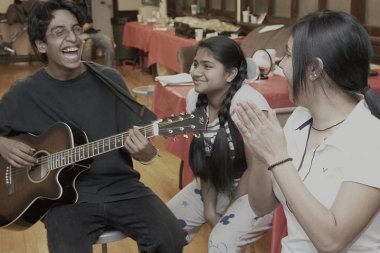
Chicago teenagers participating in APTP'due south transformative theater program.
While Trust: Second Acts In Young Lives follows Marlin'due south work with APTP, in that location are times when the documentary begins to feel like an infomercial for APTP (which has been creating transformative theater since 1997 under the guidance of co-founder and artistic managing director David Feiner). The film follows Marlin and APTP as her story is transformed from i young woman'southward personal tale to a carefully-crafted piece of theater entitled Retrieve Me Like This that ran for 7 weekends.
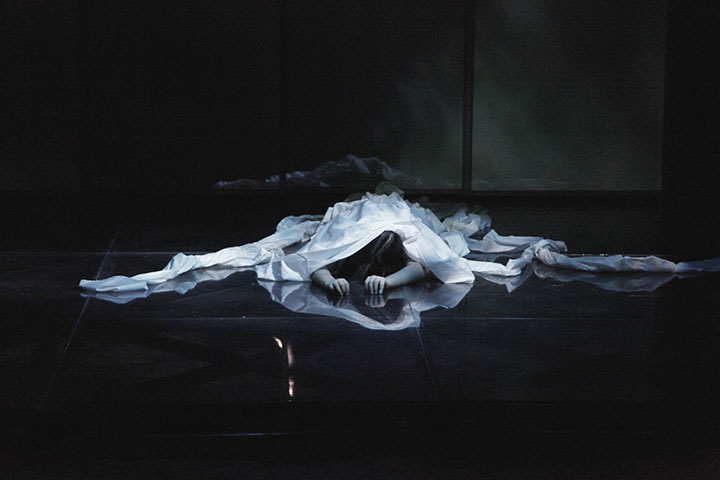
A scene from APTP's production of Call up Me Similar This
No one auditions to be in an APTP production. The ensemble is fatigued from members of APTP's program who, in the process of working on Remember Me Like This, overcame their shame nearly the subjects of rape and incest and invited their family, friends, teachers, and classmates to see them perform in the play about Marlin's experiences. APTP's co-founder, the late Laura Wiley, described APTP'southward impact on youth as follows:
It takes them within worlds they're curious almost but have no real access to. It bears witness to truths that many folks (both government leaders and lay people) try aggressively to misconstrue or to ignore. It makes dazzler and meaning out of sometimes ugly, sometimes confusing strands of human feel. It is a creative deed that, while often standing in for a retention, can actually become a new retentiveness, can become a new truth that, while telling one story, tin can actually get a new story and inspire the creation of nevertheless other stories.
* * * * * * * * * * *
Written past Christopher Lockhart and directed by Matthew D. Kallis, Most Valuable Players is my kind of documentary. The motion-picture show is devoted to showing how theater departments from regional Pennsylvania schools compete for the almanac Freddy Awards (a live boob tube issue broadcast from Lehigh Valley, Pennsylvania) that recognize excellence in loftier school musical theater productions.
Whereas the general public understands the parameters of football, baseball game, volleyball, basketball, and spelling competitions, the bear upon of having students participate in a theatrical production rarely gets a lot of attending. In describing his experiences in high school, Tom Hanks recalls "I was a geek, a spaz. I was horribly, painfully, terribly shy. At the aforementioned fourth dimension, I was the guy who'd yell out funny captions during filmstrips." In 1993, when Hanks won the Academy Laurels for Best Actor in a Leading Office for his performance in Philadelphia, he made the following acceptance speech communication:
I would not be continuing here if information technology weren't for two very of import men in my life. 2 that I oasis't spoken with in a while, but I had the pleasure of just the other evening. Mr. Rawley Farnsworth was my loftier schoolhouse drama teacher who taught me that "act well the part, there all the celebrity lies," and i of my classmates under Mr. Farnsworth, Mr. John Gilkerson. I mention their names because they are two of the finest gay Americans, two wonderful men that I had the good fortune to be associated with, to fall nether their inspiration at such a young age, and I wish my babies could have the aforementioned sort of teachers, the same sort of friends, and there lies my dilemma here this night. I know that my work, in this case, is magnified by the fact that the streets of heaven are likewise crowded with angels. We know their names. They number a thousand for each 1 of the red ribbons that we clothing hither tonight. They finally residual in the warm embrace of the gracious creator of us all, a healing embrace that cools their fevers, that clears their skin, and allows their optics to see the elementary, cocky-evident, common-sense truth that is made manifest past the chivalrous creator of us all and was written down on paper by wise men, tolerant men, in this city of Philadelphia 200 years ago. God bless you all. God have mercy on u.s.a. all and God anoint America."
Equally moving, was Rawley Farnsworth's speech when his sometime pupil received a Lifetime Accomplishment Honour from the American Film Institute:
Well-nigh Valuable Players follows the progress of three high schoolhouse drama departments as they stage productions of Les Miserables and Bye, Bye, Birdie. The film highlights the critical involvement of the area'due south arts and concern communities (including the local news team) in showcasing the Freddy Awards with a live telecast of an elaborate anniversary some have referred to as "the Super Bowl of high school musical theater." In their artistic argument, the filmmakers write:
As a social club, we cherish our music, movies, Tv shows, stand up-upwardly comedians, books and Broadway too. Yet when school budgets compress, the showtime affair that gets cut is the arts -- every bit if it's merely a dispensable afterthought to education.
The arts in schools are the perfect manner to help apply the more basic skills of reading, writing and arithmetic. Interpreting scripts, building sets, making costumes, learning to dance or read music utilise all sorts of classroom skills put to use in a more than active and fun application. The arts assistance keep kids off the streets, create expectations and set goals, offer opportunities of unique expression, build self-esteem, encourage friendships and esprit, create extended families and teach valuable life skills and lessons.
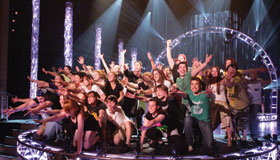
Pennsylvania students rehearsing Les Miserables
In California, Assembly Bill 2446, awaiting signature by the Governor, volition exercise away with arts educational activity equally a graduation requirement for high school vocational students (the theory behind the bill is that making the arts an elective will reduce drop-out rates). Other states, cities, and communities continue to limit or eliminate the arts in school systems. This could create a generation of students without an appreciation of the arts.
Most Valuable Players demonstrates the importance of the arts and how schools and the arts customs tin band together -- in spite of their individual struggles -- to create a worthwhile program that enriches the lives of all, while contributing to self-preservation.
The arts can survive and even thrive in spite of narrow-minded legislators and budget cuts. Communities can brand a deviation. After a huge public outcry, the Los Angeles Unified School District recently relented and now intends to cutting the arts budget by 33% instead of 50%, as previously planned. The district has also backed away from an idea to entirely eliminate all simple arts programs side by side year.
There are currently 32 other high schoolhouse musical theater awards programs around the U.s.a. like the i featured in Almost Valuable Players. They feed into a new national program that provides four-year college scholarships to two winning students. Other great efforts like the International Thespian Festival and Camp Broadway strive to go along the performing arts essential in the lives of young people. Just information technology won't be enough until all students have access to these opportunities. The key to the success of such efforts is the partnership between the communities, local arts organizations, and the schools.
Providing access to arts opportunities insures the encouragement and nurturing of the musicians, filmmakers, performers, writers, and creators of tomorrow. Furthermore, our time to come doctors, lawyers, civil servants, engineers, and business people will benefit too, as they become more dimensional individuals with an agreement and appreciation of the arts -- which can lead to their back up of the artistic customs and the overall survival of the arts for future generations.
We hope Most Valuable Players inspires communities to rethink their commitment to arts education by supporting these vital programs or creating their own. Ultimately, arts education is nearly engendering the skills necessary to go intelligent, empathic, and whole human beings. Every bit Beverly Sills once noted: "Art is the signature of civilization."
Most Valuable Players is a thrilling documentary that captures the raw energy, potential talent, explosive vitality, and budding maturity of high school students who are given the opportunity to bloom through their school'southward theater arts program. Viewers will exist especially impressed with the technology that is now available to them. Here'southward the trailer:
During his 2008 presidential campaign, Barack Obama warned that "change is hard." So far the nation has watched him put his signature to legislation that focused on healthcare reform and financial reform. Commencement Lady Michelle Obama has led a entrada confronting babyhood obesity past encouraging greater sensation of nutrition at habitation as well as at school.
While Obama's Secretarial assistant of Education, Arne Duncan, is working to address the overwhelming bug facing America'south schools, I've got one suggestion that is long overdue: Let'south reverse the priorities previously given to sports activities and arts education in our schools. Let'southward brand the arts a top priority in every school'due south extracurricular activities. Doing and then might aid develop more motivated, more than sophisticated, more adaptable, more tolerant, and amend educated students in future generations. It will also prepare them to be better citizens of the world.
To read more of George Heymont go to My Cultural Landscape
Popular in the Customs
Source: https://www.huffpost.com/entry/more-funding-for-school-a_b_757558
0 Response to "Average Percentage of School Funding for Sports Vs the Arts"
Post a Comment